
Mountain and Valley
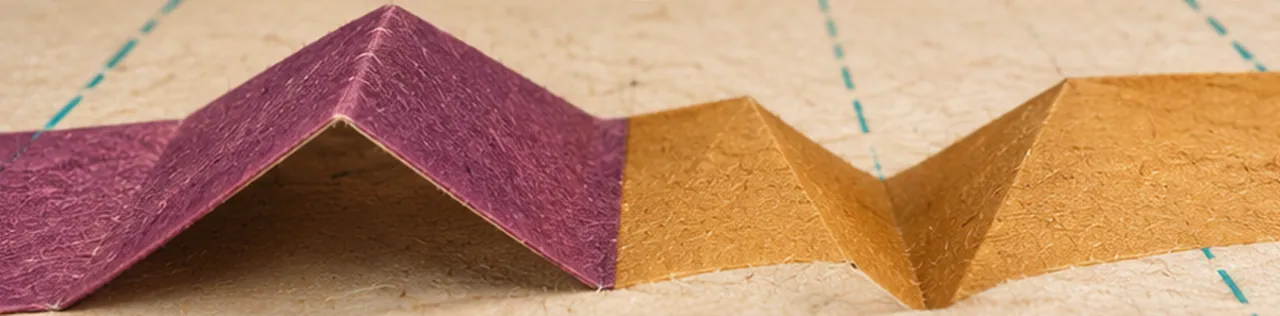
One strip lies pale side up across the work surface. Two guides cross it near the middle. The smaller guide passes beneath the corner of an unused sheet. During the first fold test both guides looked enough alike that the nearer one could seem to name the far fold. This note follows two shapes from the same starting strip and asks what the player can see before either one is used as a route. The question matters because either guide can be read correctly at rest and become confusing when the player lifts a moving panel into the light.
A raised edge with a returning shadow
Hold the first crease in a low ridge. Its far face catches light a little before the ridge covers the tail of the guide. Viewed along the side, the outline climbs and then drops by the same short interval. We allow the tiny traveler to watch from the table before setting a foot down. The player has enough time to follow the shape from its pale side to the compressed edge. A small pause in the animation gives the guide a moment to appear right at the end of the panel.
The next question was where to end the line. One long guide drew the eye past the small ridge toward the bank, making the bend feel less important than the whole span. A shorter guide could be fully covered by the early lift. We folded a sample in which the mark continues scarcely onto the second face. Even as the first face disappears, the edge still offers a short black-brown nib. That nib tells the player where the line went. It does so without asking them to count a new detail at an unfamiliar part of the table.
A low meeting in the strip
The valley sample pushes the marked crease down between two close panels. Its outline stays wider than the ridge for longer, which gives the traveler a way to tell where the dip begins. We tried a second sample with a broad teal patch. It was easy to find, but it turned both panels into scenery around the paint. With a small marker tucked into the near face, the viewer still pays attention to the physical narrowing of the space. The folded panels can carry the rhythm on their own once the mark has established which crease is being moved.
There is a point where the lower surface matches the color of the cut board behind it. We use a small edge highlight there and only there. The shadow leaves that highlight clear as the hinge turns, so from a low angle the viewer can see that two panels meet. A higher camera shows the difference in the symmetry of their movement. We keep both views consistent by anchoring the shift around the crease itself. Otherwise the closest outside edge might appear to travel farther just because the camera moved away at the same moment.
What this sample settled
The two shapes can share a paper and a lighting setup when a mark extends slightly past the front face. The player needs to see how much of the mark is left, and whether the paper climbs or dips at the arrowless guide. The question of loading each shape belongs to a later study. In Paper Span for Two the ridge eventually meets a slowly changing load. The Backfold Landing turns the earlier face out of view and asks how much orientation the edge can hold. Turn the Mark Over picks up that more difficult case. The pocket study starts already under the ledge, after the player has met this simpler pair of crease tracks.