
Turn the Mark Over
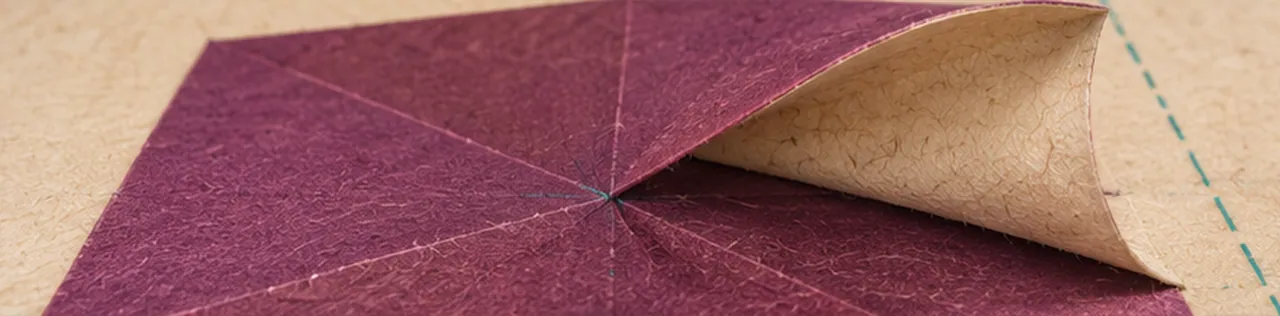
The camera starts looking squarely down on a free panel. A small teal stroke appears to point under the corner of a pale shelf. Rotate the fold inward and the stroke appears to shorten. Close the fold farther and the point disappears. An earlier version replaced the stroke with a new mark on the back. A person following the original mark had little reason to believe the second belonged to the first. We wanted to leave one short detail whose movement told the viewer that the same fold had continued past the edge of the view.
Keep a visible part of the same stroke
The sample starts at the edge of a practice sheet in warm brown. Its working mark runs over the bend and onto a pale underside. Looking squarely down, the far end of the mark is hidden. As the panel lifts, a small stroke on the side arrives before the face disappears. Follow that smaller stroke under the edge and the panel still appears connected to the work you were trying. We gave the visible segment a dull finish so it changes with the paper in the light instead of standing out as a fixed painted overlay.
The border around the turning surface was an unexpected source of confusion. In the first sample the join had a black stroke on both edges. As the panel rolled sideways, both strokes approached the same space near the bottom of the view. A narrow edge left in paper color produces two colors around the hinge instead of two dark lines. As a result, the approaching mark is easier to follow from either side. This observation carried over to a panel with a short hook. The mark could stay inside a small strip without looking detached from the structure around it.
Follow with the eye at working height
Put the view just under the ledge. At that height the paper moves across the background in a shallower arc. The color break stays near a scratch in the lip. A player can tell which object moved by checking the scratch. We had tried adding a second moving guide behind the fold. Some views lined both guides up edge-on, so the new guide made the original problem worse. Keeping the scratch fixed establishes which side you are looking from and leaves a location to return to while the other panel moves.
The final check reset the whole assembly with the unused face underneath and the working mark on the far side. Here the shorter part of the stroke appeared first. Following it in reverse still led to the correct front face. The test also showed that the time between the two parts of the stroke coming into view can be very short. A change in lighting might hide most of the edge during that interval. We will keep the turning action under player control so a person can hold it where they need to see it.
Use it beside an obstacle
The Backfold Landing includes a pocket where the end of a working mark disappears for a while. The mark leads into a channel whose wall surface is visible from below. The player can use that surface to tell when a small panel has seated far enough to carry a foot. Mountain and Valley uses the earlier, simpler version of edge tracking on a strip you can see from both sides. Readers can put the cases beside one another using Crease Matrix. The mark on the reverse remains one of several clues: the player should still be able to see the resulting lip and move the small traveler in a way that agrees with the placement they just observed.