
Paper Span for Two
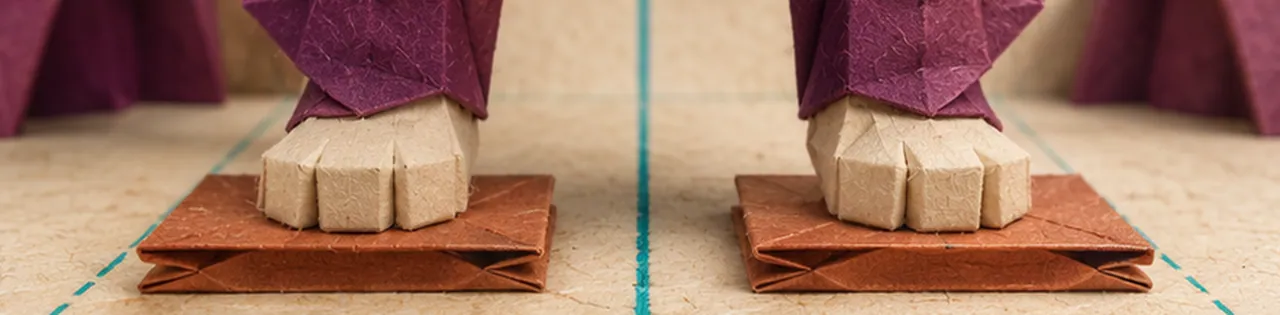
The traveler reaches the edge of a long work surface. Beyond it sits a square cut from the same pale board, high enough that the little front foot cannot simply reach across. Between them is a sheet with three scoring marks. The broad one nearest the edge runs the direction the traveler will move. Two shorter marks cross it. Paper Span for Two is an original game concept about distributing the weight of a small traveler between two visible footholds. Its bridge is built from the sheet already in the scene. The player moves the sheets, not the banks.
Place weight one foot at a time
Lift a short panel and see its shadow touch the fold behind it. Shift that panel until the shadow sits inside the open gap. The game lets you offer the first foot to the upper face while leaving the body on the bank. The far end floats a little above the receiving surface. One adjustment brings it down, but the little bump the traveler was about to use is now farther away. This approach makes the compromise visible before the player has chosen to cross.
The traveler pauses on one foot as long as the deck can hold in that position. Move the second foot into view and you can compare where it hangs in relation to the crease. A thin line under the bridge becomes a clue that the load is moving forward. If an ankle obscures the line, the player can slide the view along the bridge and inspect the next exposed edge. There is time to try a lower rib when the first one takes too much reach out of the sheet. An early step can even be safely moved back to the bank without unfolding the entire arrangement.
Follow the joints across a small world
Work tables are worlds in their own right at this scale. A scored line can feel like a track, whereas the round edge of a binder board reads as a tiny bluff. The supporting scenery stays quiet. Its surfaces are cream and muted olive, with brown cut edges catching two kinds of light. The traveler has flat paw-shaped soles and a clear ankle break. Players can tell which surface is taking weight even when only the forward half of the traveler is on screen.
The wider step is built beside a rectangular notch. A paper edge can catch this notch from one side, but if you turn the rib over you make a shorter, steadier route. The player can also spread the work between two ridges. This second treatment has the side effect of placing the lead foot on the flatter part of the bridge, so you have more room to make the next panel. The level rewards a sequence of sensible adjustments instead of one complicated flourish at the beginning.
Current work
This concept is being explored as an in-development prototype. We are testing where a player looks after the first visible sag, and whether a held first foot gives them enough information to try another panel. Too much deformation makes the crossing feel already lost. A short change along the edge preserves time to observe. Weight at a Corner describes the way a flat load moves toward a crease across a short test. A Sole at the Edge takes a first-person look at the tiny differences visible around the traveler’s front foot.