
Weight at a Corner
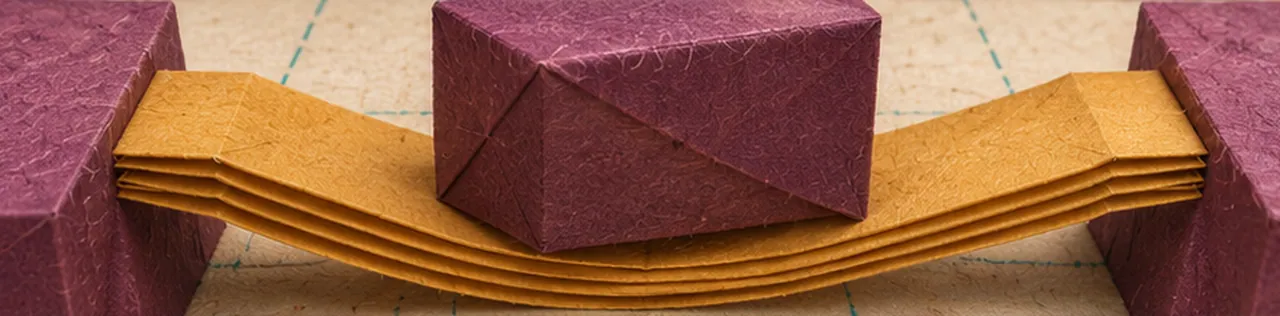
A small square weight can bring a flaw in a bridge into view earlier than a whole traveler step. This test sits a folded block a little to one side of a ridge. It records the dark edge where the deck sinks, the part of the far panel that separates from its rest, and the position of a working mark before and after the weight lands. The two bridges are built from the same score pattern. One has a quiet bend near the receiving surface. The other spends that part of its sheet on two shallow layers that run up to the bank.
Keeping a starting mark
First we center both bridges with a strip of warm paper visible behind the free end. Then we hold the little block just over the same pale scrape on each deck. The weight goes down without bumping the far side. On a flat bridge, its first movement can be read as two dark lines sliding toward one another. Now look at the last line nearest the receiving surface. The strip behind it gets taller even though the block went down. This is the change a player should be able to notice while adjusting the free panel from the far side of the joint.
The layered bridge behaves differently. The dark area under the weight stays fairly steady at first, but an outer fold bends sideways. We made this motion large in one sample and learned that it drew attention away from the part of the ledge about to lose contact. Scale the bend back. The supporting face is still moving and the player can read its value from how long it remains against the board. In an early game build a faint teal point rides near that edge, so a viewer can follow the same intersection on either side of the pause.
Support changes away from the block
At the turn, the far corner can lift before the deck looks soft. Finding that corner from an overhead view is surprisingly hard when it sits against pale board. In one sample we had shaded every underside. That pushed the far corner into the same dark background as the area beneath the weight. A narrow edge lit by a low lamp brings the separation into view without turning the whole model into a striped chart. Move the lamp instead of adding new paint to the structure and the clue remains a change in the folded paper.
The next pass places the block closer to the edge. One finger of the shallow folding sample now separates almost immediately. The first motion is small, but we can see it if the camera is left near the deck. A full overhead view shows where the block is placed and little else. From just below the support the gap is visible, though the block practically disappears. Putting a fixed working mark at the corner offers a way to hold the location while the viewer moves from one useful viewpoint to the other.
What the traveler adds
We still need to compare the square load with the front foot of the traveling character. A square weight stays quiet while the surface responds. A paw can rotate a little when the ankle extends and shifts the pressure sideways. That change might move the useful shadow to the other edge of the deck. Paper Span for Two keeps the rear foot on the bank during this test. A Sole at the Edge documents the contact patch we plan to use. The next test stops just after that paw goes down, then checks which crease tells the clearest story about where the load is going and how much room the following step has left.