
A Sole at the Edge
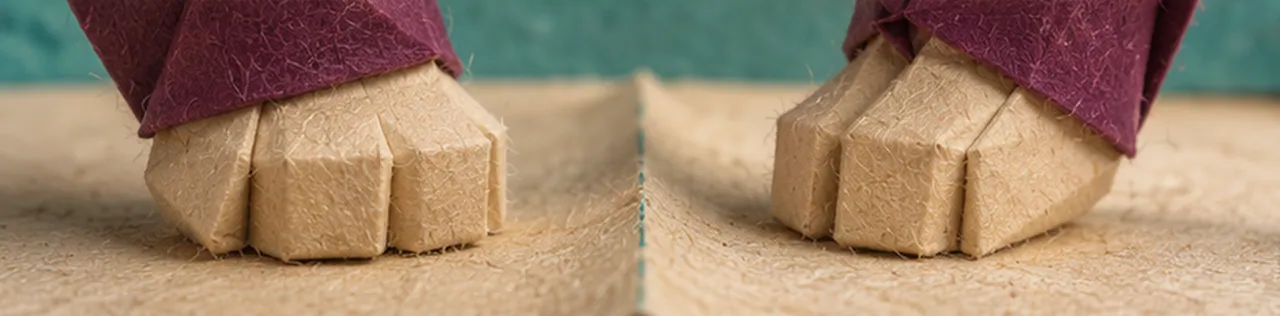
A paw made from folded paper can look as if it is resting on a seam before it touches the deck. Its contact patch is a narrow face made of coarse fiber. The first version of our traveler had several tiny cut corners near the toes, so it was hard to tell whether a dark triangle belonged to the foot or to the next piece of the bridge. This test follows one approach to the same ridge with two different toe angles. The view moves down to a level where the card edge and the bottom of the sole can be seen together.
Choose a place to pause the step
Bring the foot forward until its lower edge sits over the light patch by the ridge. The far half of the toe still hangs over empty space. If you lower the ankle from that position, a pale underside remains visible behind the first contact. We allow the traveler to hold there before leaning forward. This short pause lets the player see the support as a physical change. When we removed it in a test, the contact patch appeared late and then immediately disappeared beneath the paw. A shallow hold gives the viewer a choice about whether to complete that step.
Angle the same foot a little closer to the ridge. Its heel moves out of view sooner, though the front pad has more room. Watch the fold beneath it rather than the curve of the ankle. The side of the deck can sink a little while the tip of the foot maintains a small space. We traced both situations with those two lines on a sample. Some views made the shadows join before those lines actually met. Offsetting the light slightly made the contact patch visible and kept the moving shadow useful for following the bend in the deck.
Keep the printed edge behind the contact
The original guide was a dark slash across the middle of the pad. It gave the viewer a place to look but went entirely beneath the sole once the paw came down. We moved its end near the trailing corner, where a small part remained visible after the pause. The revised guide shows which deck face now bears weight, but the surface beneath the player still does the work of indicating how the bridge moves. On the thinner sample, the same guide points to a place where the cut paper changes level, even in light flat enough to soften the cast shadow.
The difficulty increases near the next narrow ridge. The toe must come down farther from the previous support, where more of it can project off the side. Tilting the view nearer the passage reveals the spare strip beneath it. That view places part of the resting paw in front of the free edge. A person can return to the previous camera without changing the fold, then check again after moving the paper. We will compare these movements with two views of the same contact before choosing what to keep in the main bridge route.
What the next prototype tests
Paper Span for Two gives the player another decision between the first held foot and the following step. The bridge might benefit from moving the nearer ridge, or the second paw might be ready to settle farther from the edge. This open note covers the view we use before testing that choice. Weight at a Corner gives the slower example with a square load and lets us compare the deck without tracking the ankle. In the next sample we want the short pause to show what the character can feel at the edge without making the whole move look frozen. The pale line at the back of the sole is the first thing we will check.